

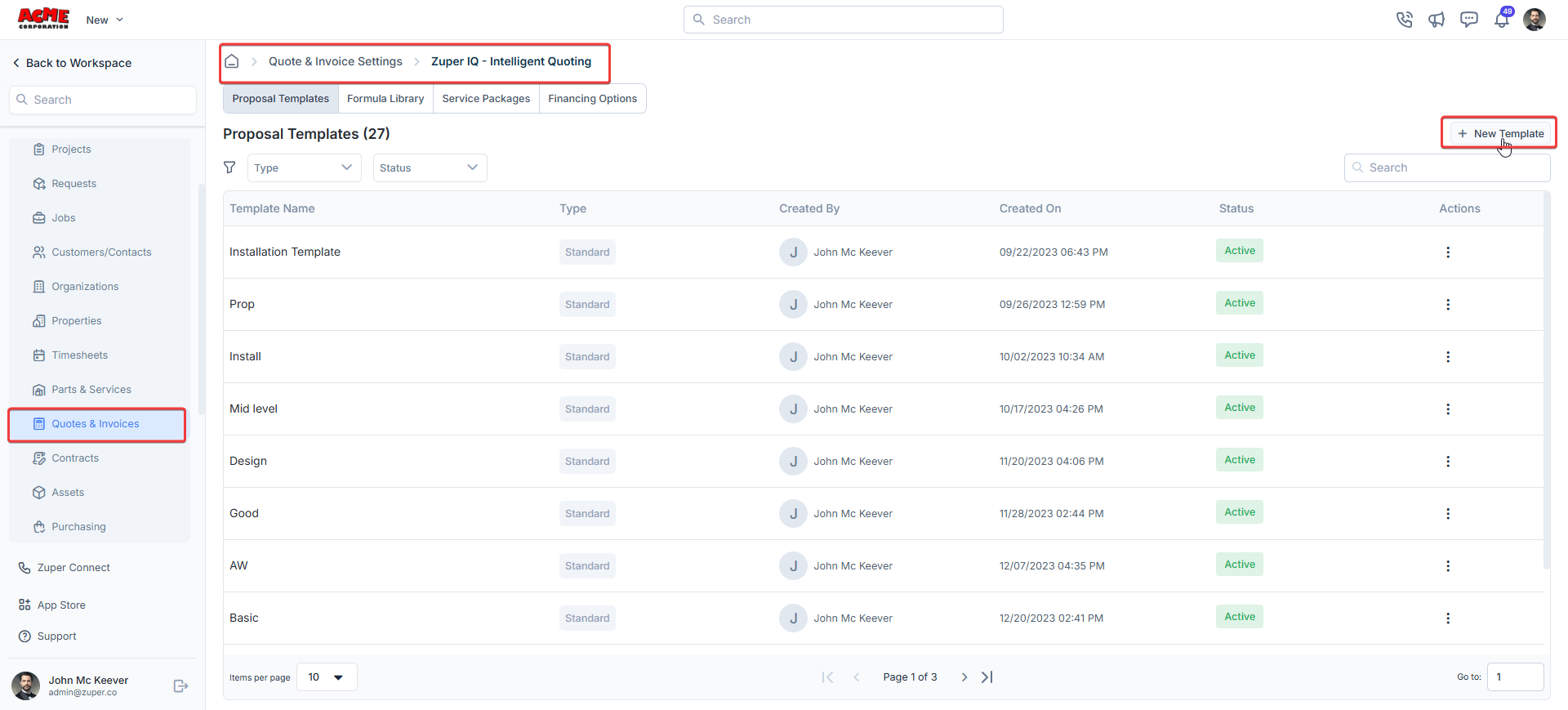
Let’s start creating a new proposal template:
- Navigate to Quote Settings → Zuper IQ – Intelligent Quoting → Proposal Templates.
- Click + New Template.
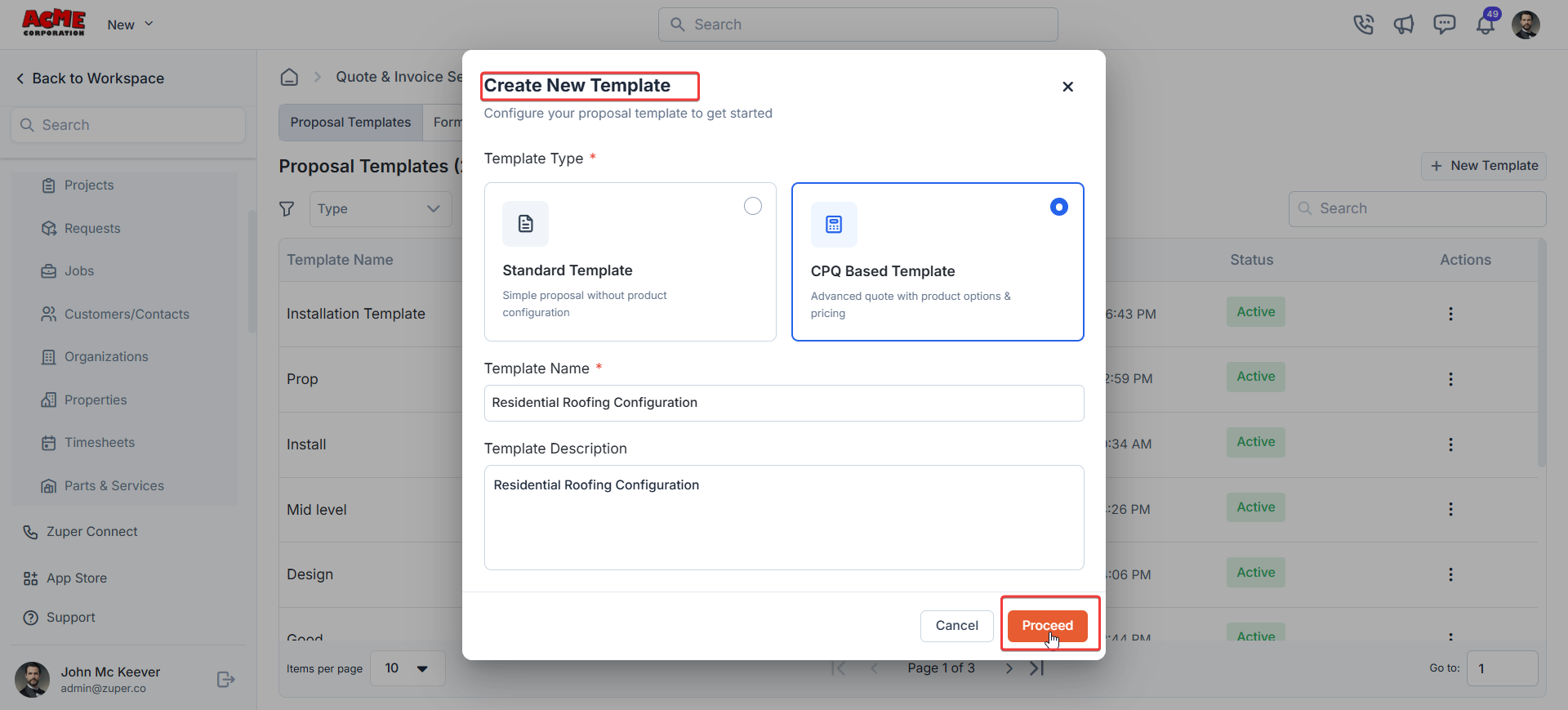
- You’ll see two template types:
- Standard Template – Great for simple, fixed-price proposals.
- CPQ-based Template – Ideal for configurable, multi-option proposals that use formulas and rules.
- Choose a CPQ-based Template, give it a descriptive name (for example, Residential Roofing Configuration), and click Proceed.
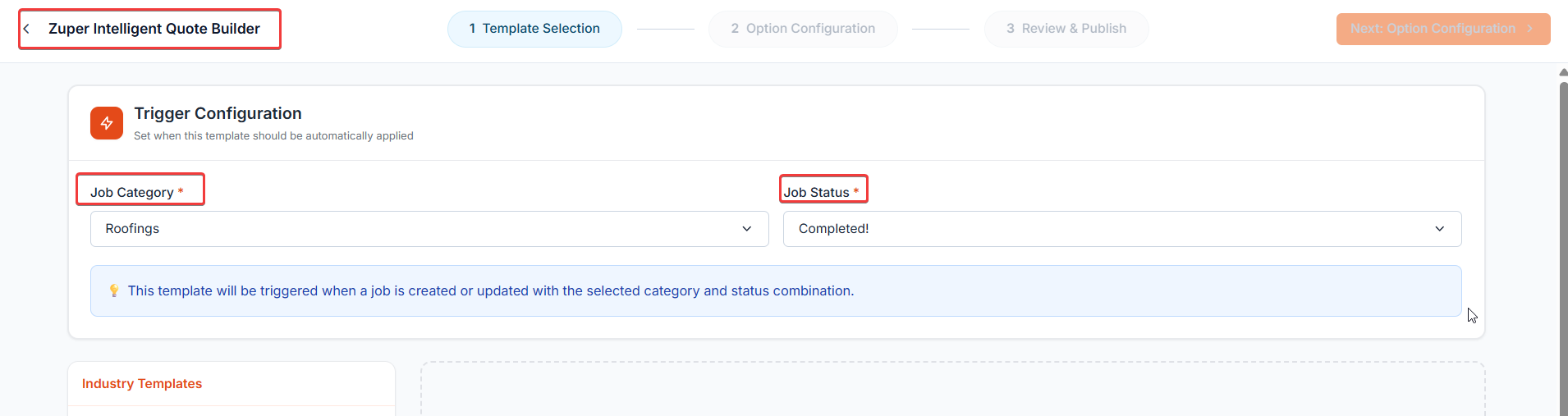
Select Template triggers and options:
Every CPQ template begins with automation rules that tell Zuper when to apply it automatically. You’ll set:- Job Category: Select for which category this template should apply (e.g., Roofing, HVAC, Electrical).
- Job Status: Choose when the proposal should trigger (e.g., Completed, Ready for Estimate).
- Industry Templates – Preconfigured templates for brands like Owens Corning, GAF, or CertainTeed.
- Generic Presets – Options like Good / Better / Best, Option 1 / 2 / 3, or Single Option.
Configure Packages and Items
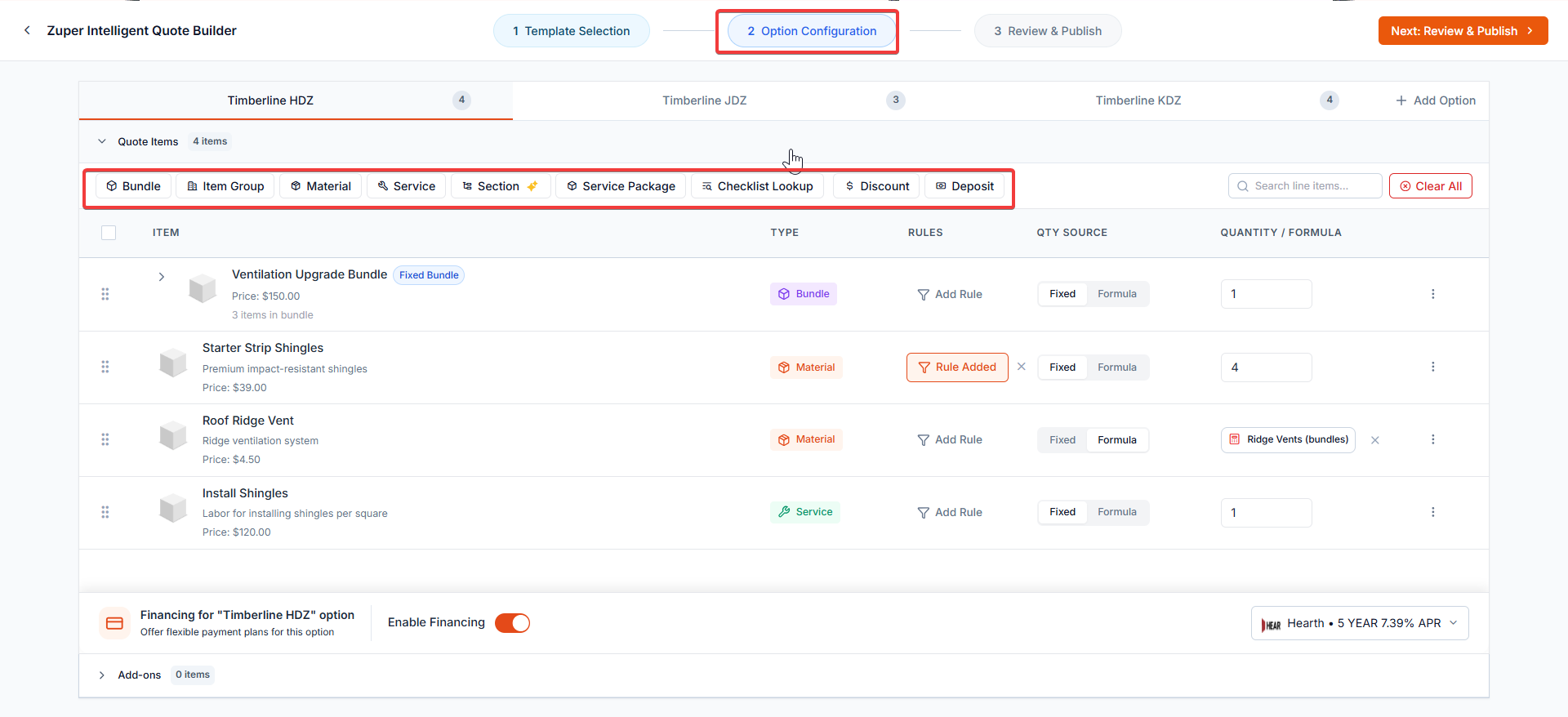
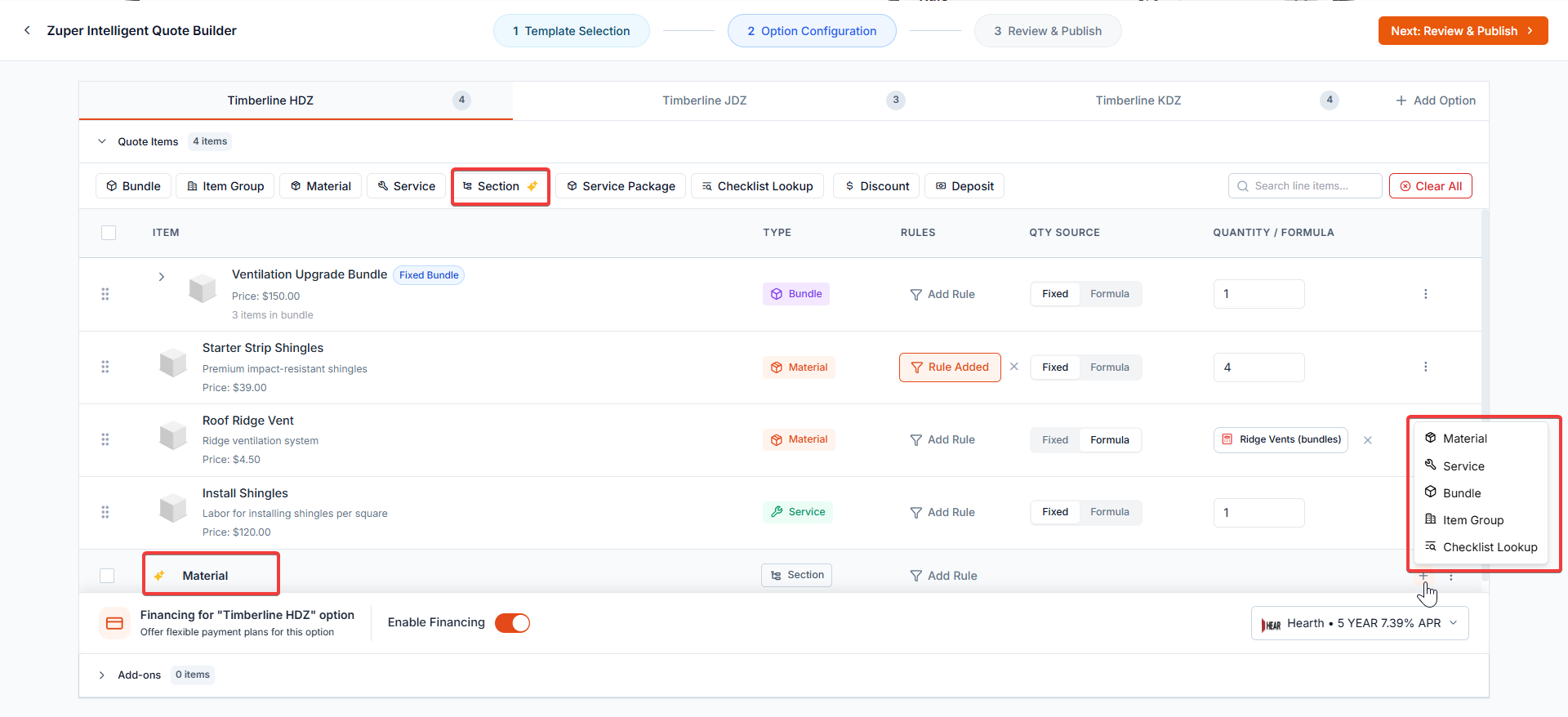
The Package Configuration page is the heart of your CPQ setup. Here, you define what products, services, bundles, or service packages appear in each option (such as Good, Better, Best). You can add:- Bundles– Predefined groups of materials or services.
- Materials – Individual catalog items like shingles, tiles, or sealants.
- Services – Labor, inspections, or custom charges.
- Service Packages – Combined service offerings.
- Sections – Used to group related items for easier readability.
- Discount – Apply pricing adjustments directly within each package.
- Checklist Look-Up – Add items from the checklist lookup fields directly to an option. You can apply the quantity as Fixed, which uses the value entered during lookup, or as Formula, which calculates the quantity using the product’s default quantity formula set in master.
- Deposit – Define an upfront amount for an option using either a percentage of the proposal total or a fixed amount.
Add-ons
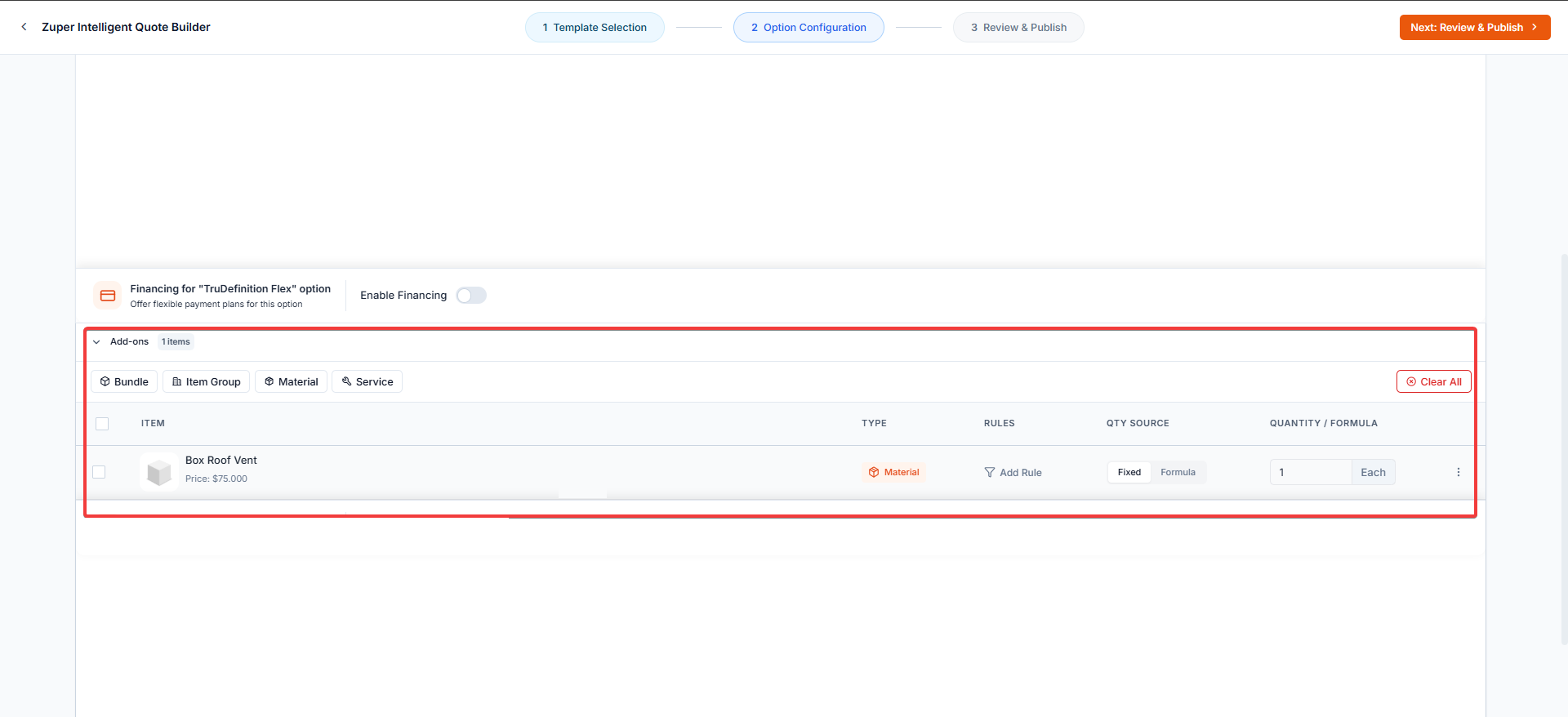
Add-ons in CPQ are optional items tied to each option, allowing customers to select additional services or items before approval. Add-ons configured at the Service Package level automatically flow into the CPQ options Add-ons section.Note: CPQ Item Rules and Formulas are supported for the Add-on items too.
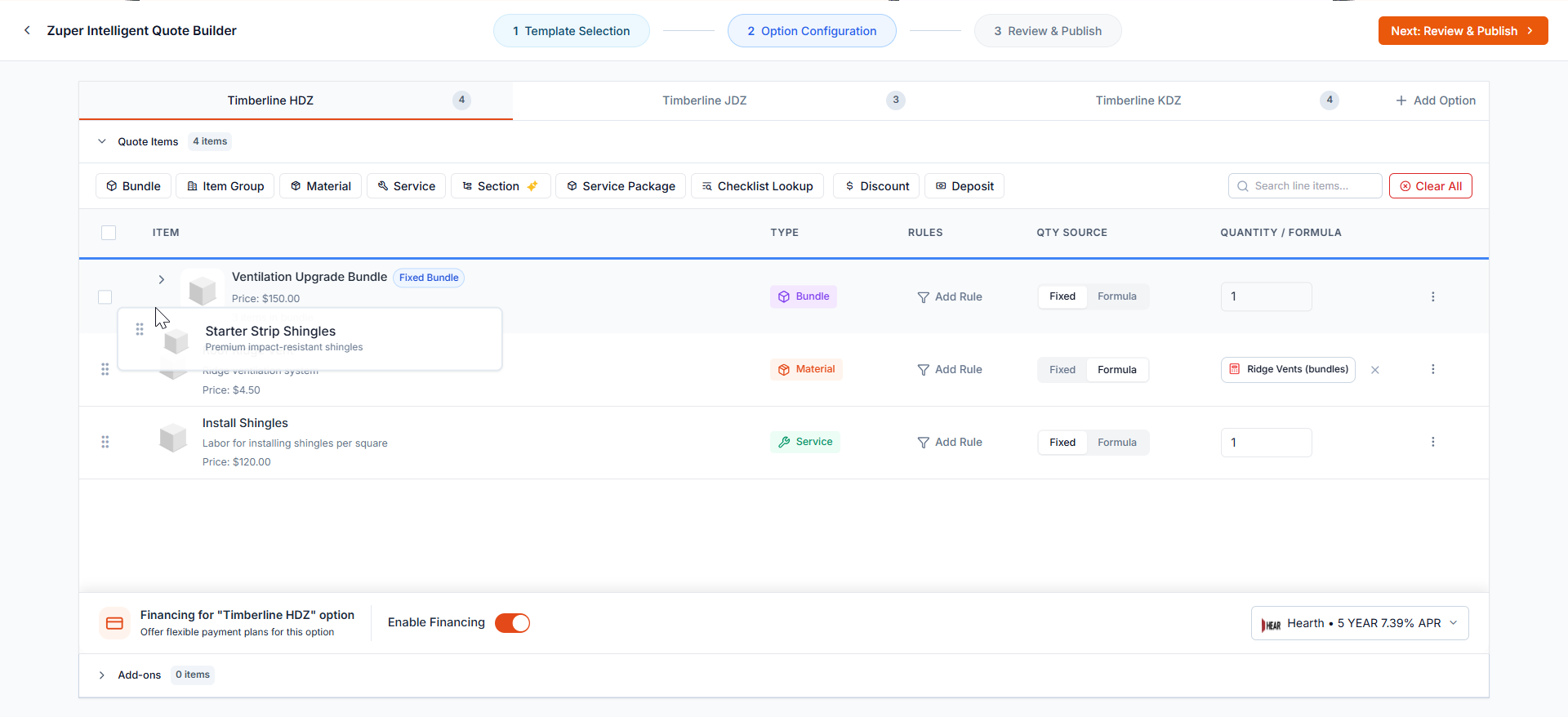
To add more options, click Add Option and specify the option details. For each line item, you can set:
-
Rules: Click Add Rule beside a line item to define when that item should appear, be hidden, replaced, removed, or have its markup adjusted automatically based on Job details. If you need to remove a rule later, simply click the X next to the rule.
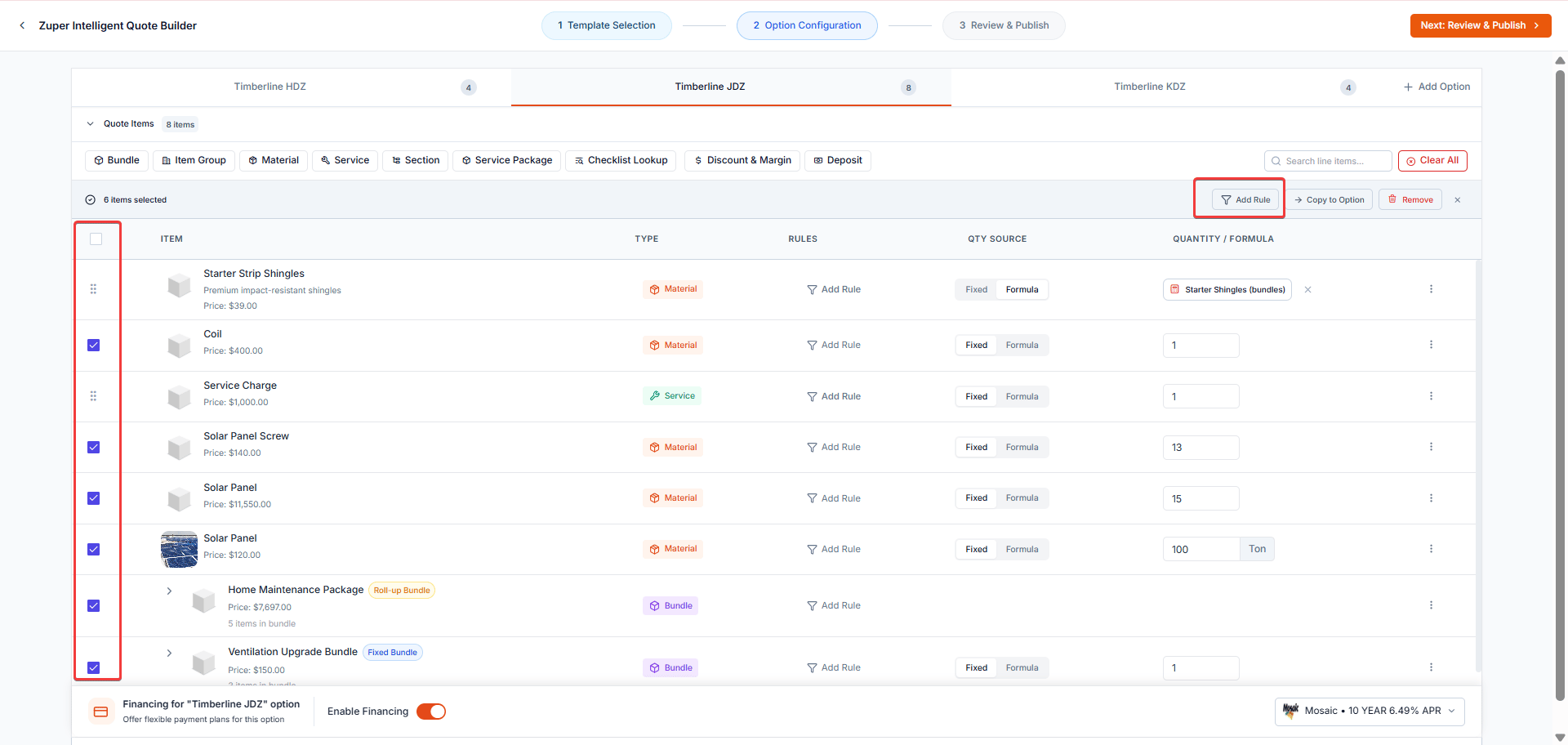
Tip: To apply the same rule to multiple items at once, select the checkboxes next to the required items, and then click Add Rule from the toolbar. The Conditional Rule panel opens, allowing you to configure the rule once and apply it to all selected items when you save it.
-
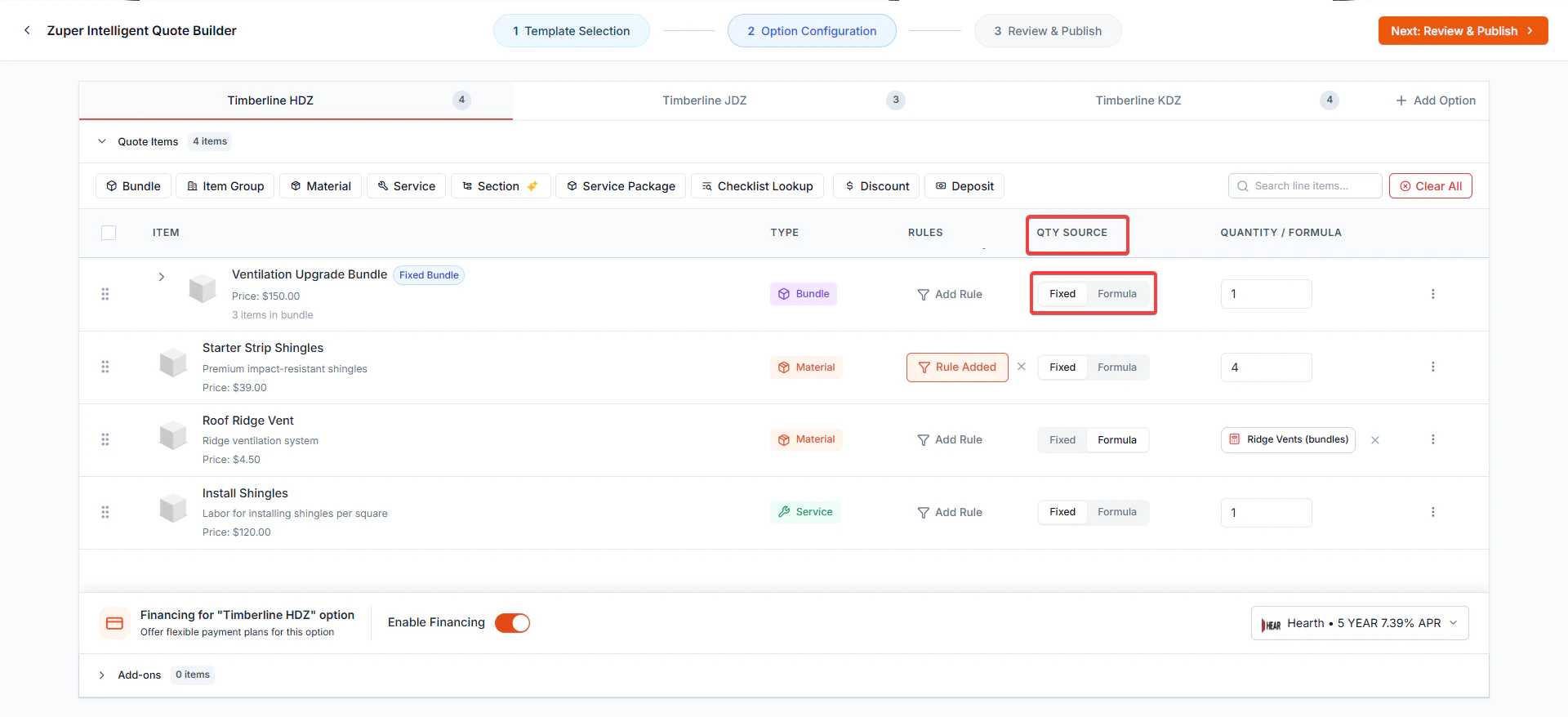
Quantity Source: Fixed (manual entry) or Formula (automatically calculated using your Formula).
If a Quantity Formula is defined in the part or product master, it automatically populates in the line item when you select that item in a CPQ template option. You can keep the auto-populated formula or modify it in the template to meet specific job requirements.
Enable Financing Options
At the bottom of the configuration page, you can toggle Enable Financing to On for the package (e.g., “Financing for Better Option”) and select the provider and their plans.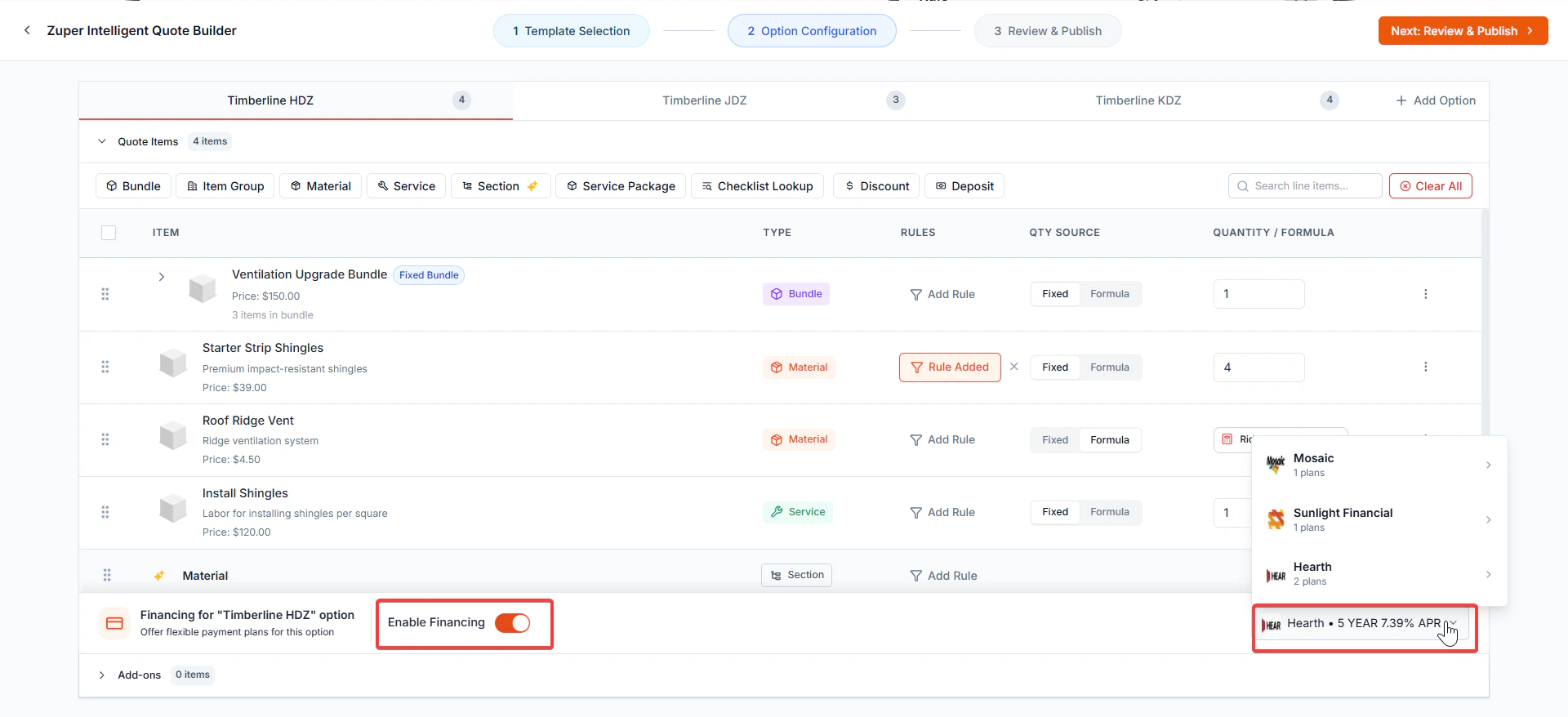
Preview and Refine Package Options
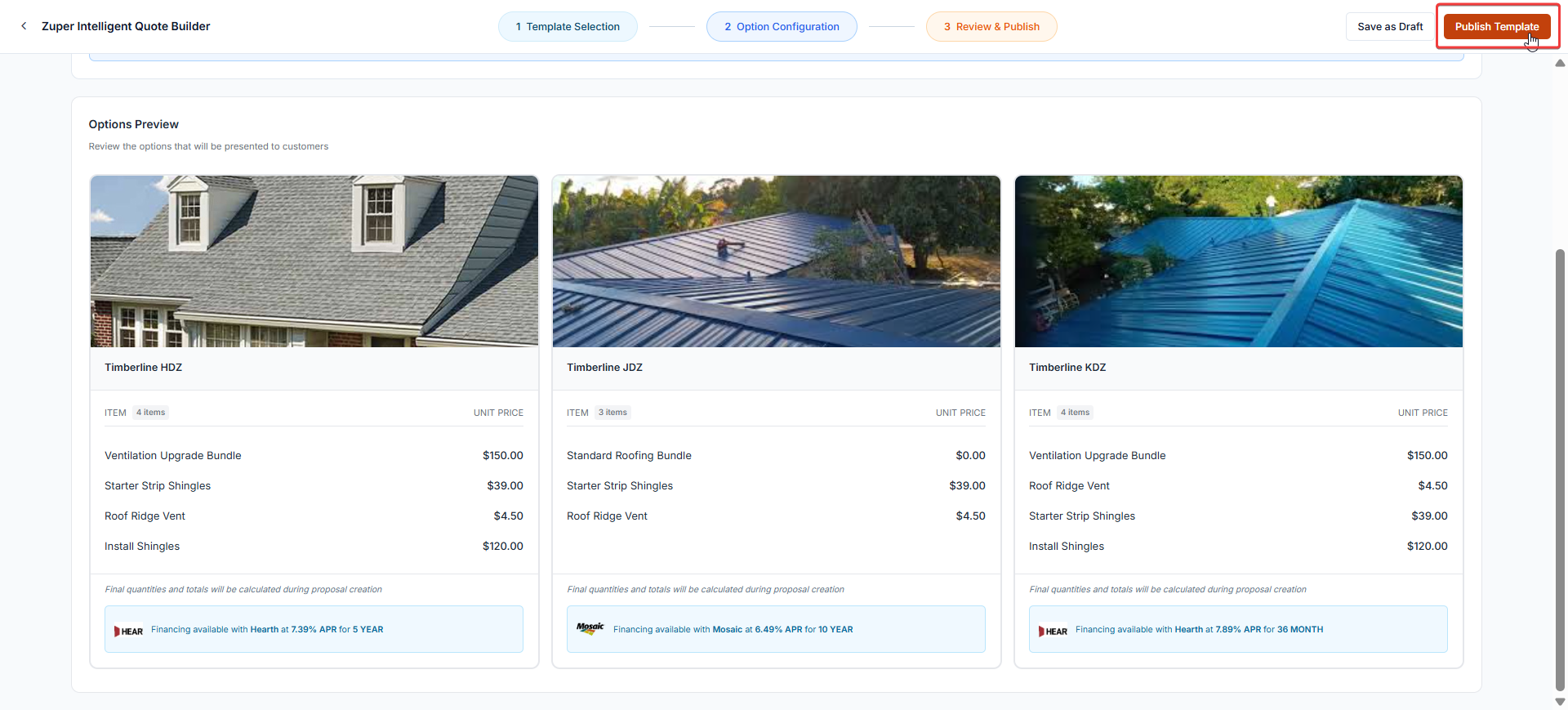
Once your items, formulas, and rules are set, you’ll see a Package Options Preview.Each option (Good, Better, Best) appears as a visual card with:
- Item list and descriptions
- Unit Selling prices
- Package images
- “Recommended” labels for highlighting preferred options
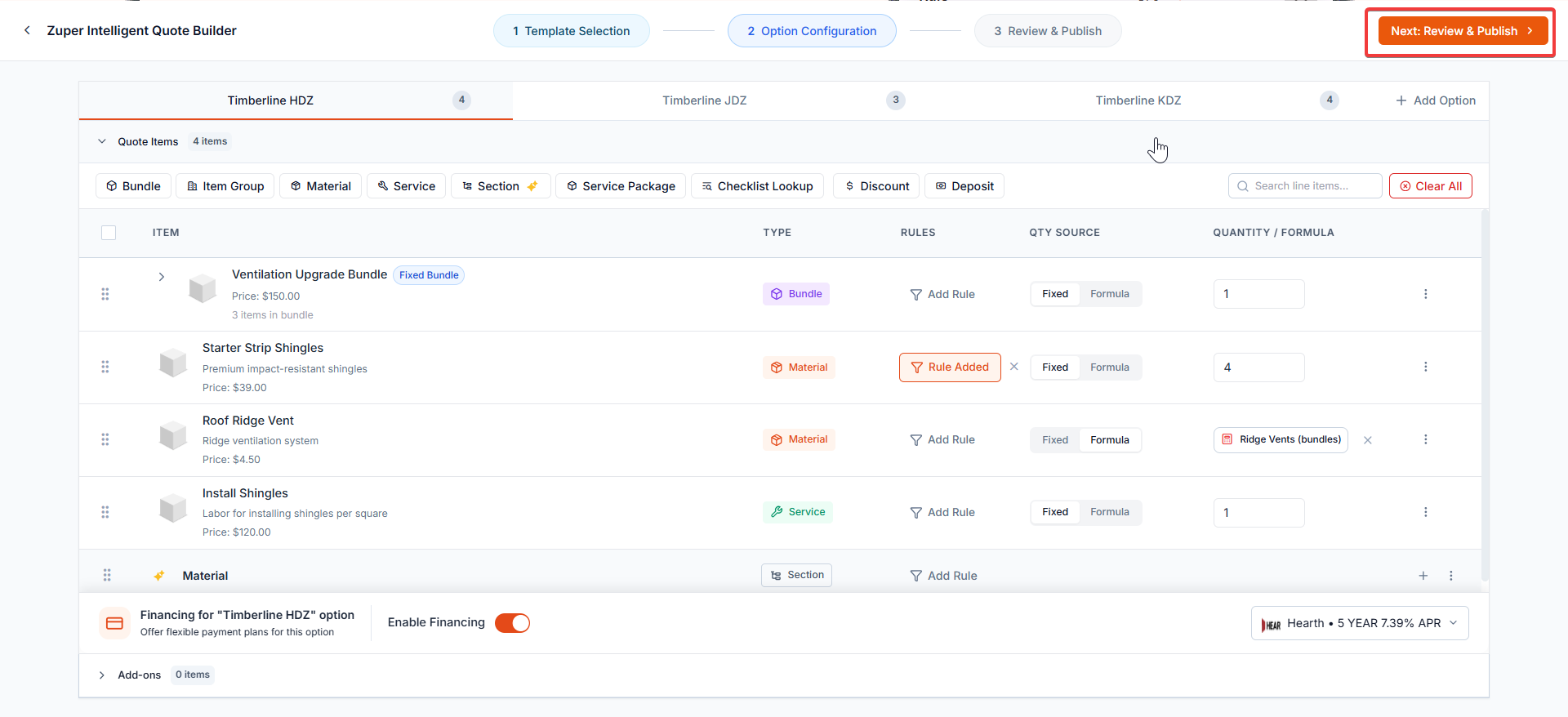
Review & Publish
- Under Select Proposal Layout, choose the layout you want this CPQ template to use. Each layout controls the sections of your proposal, cover page, package summary, estimate options, and signature page.
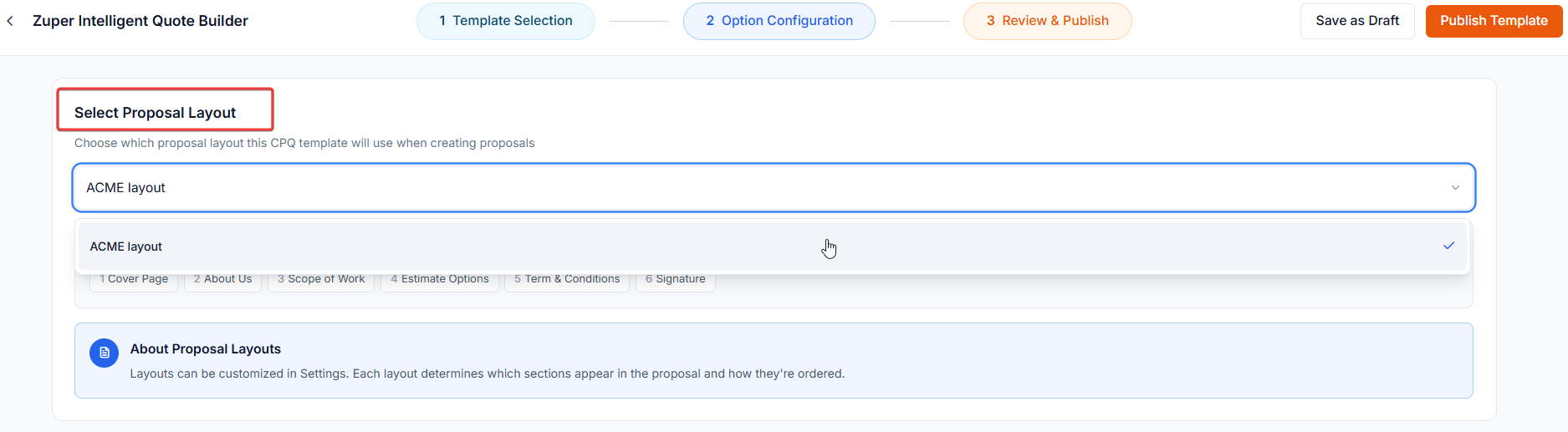
- Use Save as Draft if you want to test or adjust later.
- Click Publish Template when ready.
Frequently asked questions
In CPQ proposals, what happens if a measurement token or a checklist value is not filled in or is null, and how is it used in a formula calculation or a conditional rule?
In CPQ proposals, what happens if a measurement token or a checklist value is not filled in or is null, and how is it used in a formula calculation or a conditional rule?
Zuper automatically treats any missing/null/blank value as 0 during calculations, so your proposals always generate successfully. For example: Formula: @Roof_Area * 1.1 (adds 10% waste) → If @Roof_Area is missing → treated as 0 → quantity = 0 (item will not be added). Conditional rule: “Add ice & water shield IF @Eaves_Length > 20” → If @Eaves_Length is missing → treated as 0 → condition Rule(defined).
What happens if the calculated quantity of a line item is 0?
What happens if the calculated quantity of a line item is 0?
If the calculated quantity is 0, the item is automatically removed from the proposal option.
Why do custom field types appear differently in CPQ?
Why do custom field types appear differently in CPQ?
When you create custom fields in Checklist or Inspection in Zuper, you may configure components like Single Line Text or Multi Selection.
When these fields are used in Zuper CPQ (Intelligent Quote Builder), such as while creating conditional rules, the system displays simplified field type names like Text or Checkbox.
This is expected behavior. CPQ simplifies the field type labels so they are easier to read and use.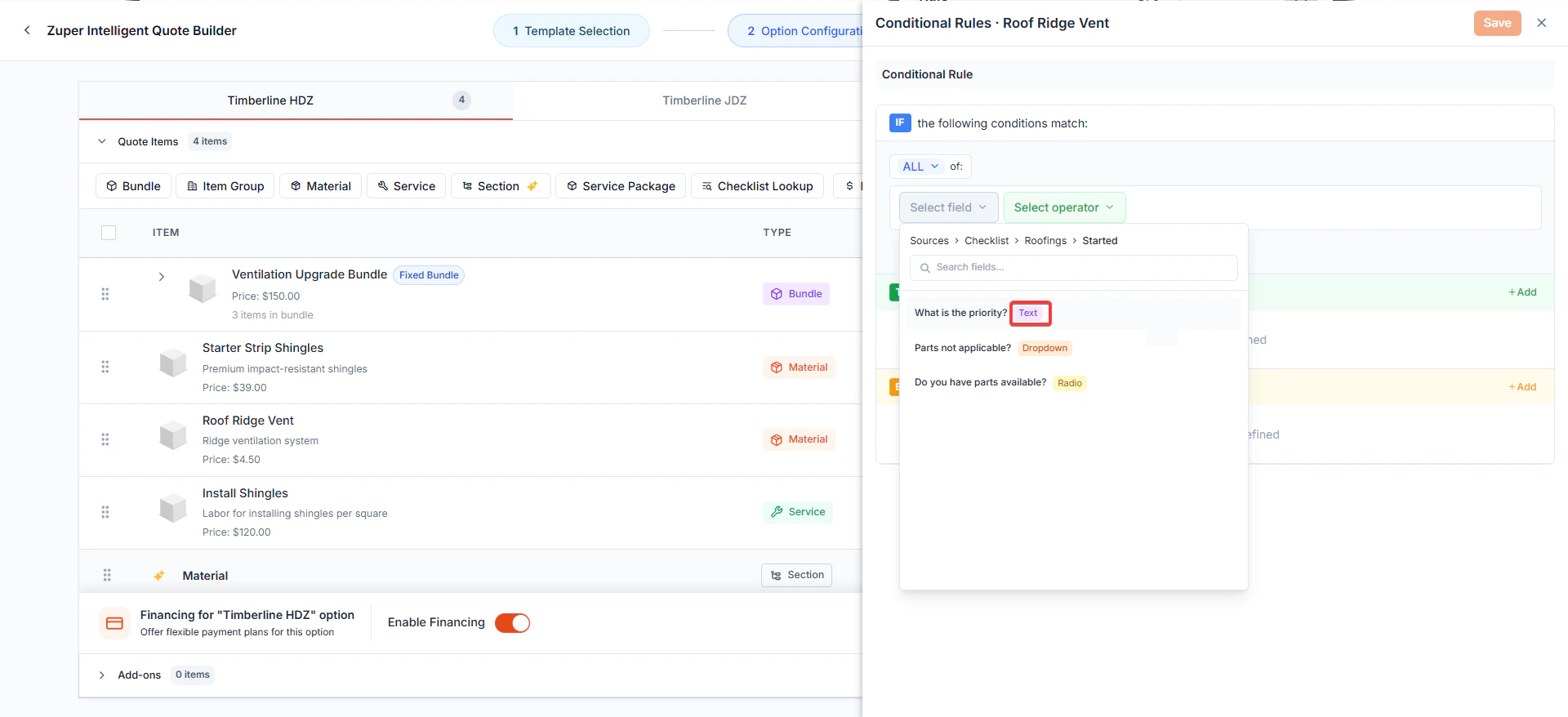
When these fields are used in Zuper CPQ (Intelligent Quote Builder), such as while creating conditional rules, the system displays simplified field type names like Text or Checkbox.
This is expected behavior. CPQ simplifies the field type labels so they are easier to read and use.